I have started using Claude as an analyst for my trades. Not to trade for me. To do the research I would otherwise skip, and to argue with me before I press the button. This is the first trade from that arrangement, written up before the result is known so that I cannot tidy up the story afterwards.
Trade summary
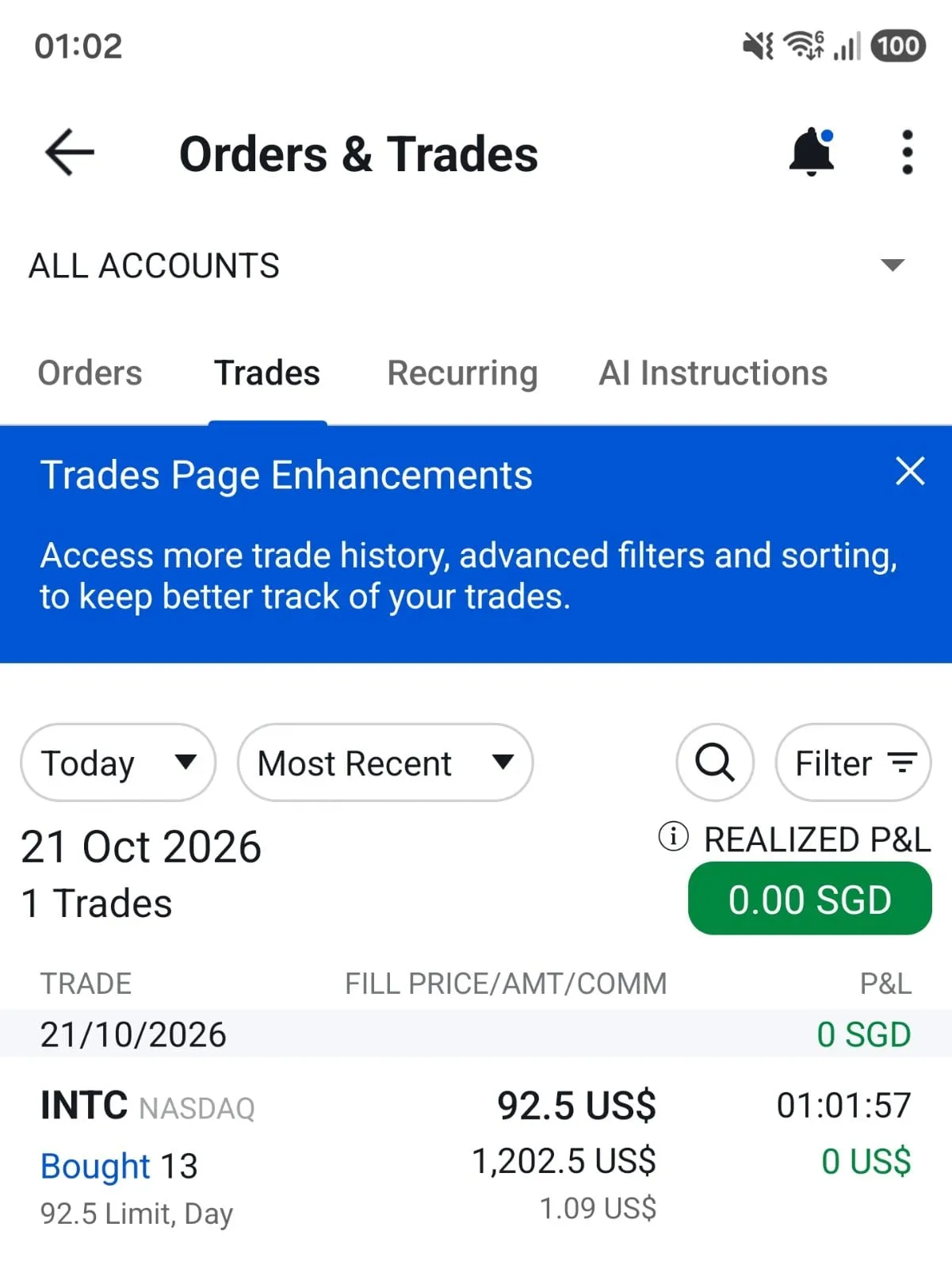
| Action | Buy |
| Ticker | INTC (NASDAQ) |
| Quantity | 13 shares |
| Fill price | USD 92.50 (limit) |
| Cost | USD 1,202.50 + USD 1.09 commission |
| Executed | 21 October 2026, 01:01 SGT (20 October, 13:01 ET) |
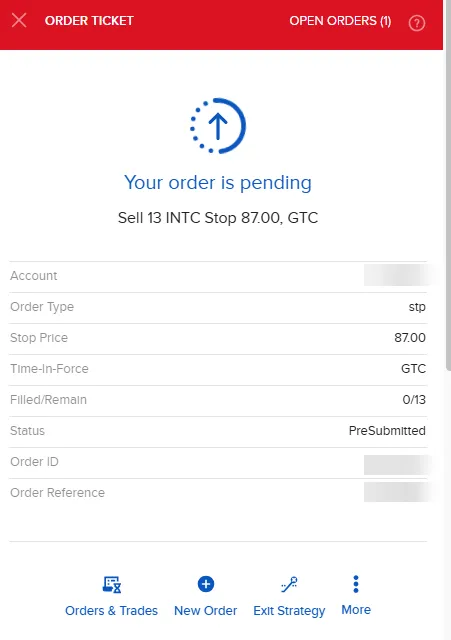
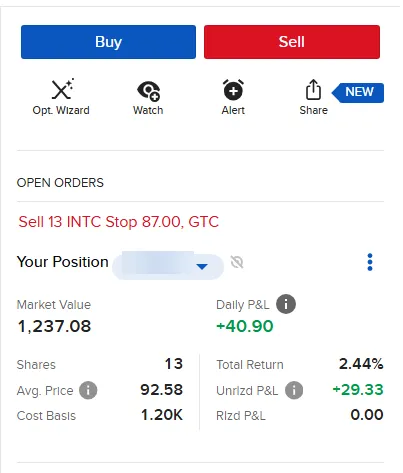
| Stop order | Sell 13 at USD 87.00 stop, GTC. Submitted, not executed. |
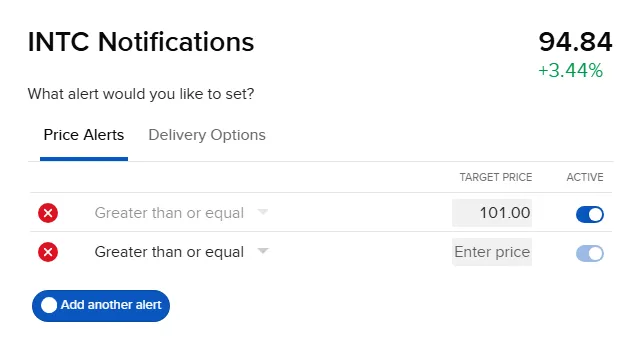
| Profit target | USD 101.00, price alert only. No order placed. |
| Status | Open |
Why I am doing this
My reason is simple: I want to test AI-assisted trading with small amounts of money and see whether it makes my decisions better or just faster. The position is half of a small pot. If it goes wrong, the loss is one I can afford and the lesson is cheap.
What I believed before the trade
I like trading well-known names. The patterns are easier to read and the news is easy to find. Intel is one of those. I had no strong view on the company before this week. My instinct on the night, after reading the analysis, was no. I said so. Then I bought anyway. I want that on record.
The evidence available at the time
This is what Claude pulled together on 20 October, Singapore evening. Prices are from the 19 October US close unless stated. Sources are listed at the end.
The case for
- On 19 October Tesla was reported to have signed on as a customer for Intel’s 14A foundry process. The deal size was not disclosed.
- Intel’s last quarter (reported 23 July) beat expectations clearly: EPS of USD 0.30 against USD 0.10 expected, revenue of USD 16.1 billion against USD 14.4 billion.
- The next report is due 29 October after the US close. Consensus is EPS USD 0.28 and revenue USD 16.5 billion, both well above the same quarter last year.
- The stock had fallen about 25 percent in 12 trading sessions, from a close of USD 120.23 on 30 September to USD 89.85 on 16 October. Twelve of the fifteen sessions were down.
The case against
- The JPMorgan move that made the headlines was an upgrade from Underweight to Neutral with a USD 85 price target. That target is below the price I paid. It was a “stop shorting” call, not a buy call.
- Intel is still losing CPU market share. Server share has fallen from 77 to 53 percent and PC share from 81 to 68 percent, per the JPMorgan note as reported.
- Foundry revenue from outside customers is around USD 1 billion a year. TSMC’s is around USD 150 billion. The foundry story is early.
- Gross margin is about 39 percent.
- Technically, the stock was below its 20, 50 and 200 day moving averages (roughly USD 93, 98 and 109). The 19 October candle opened at USD 94.53 and closed at USD 92.03, near its low.
What Claude suggested
Claude’s first read, earlier in the evening, was amber leaning red: a strong downtrend, a weak close on the upgrade day, and a price target below the market. It also noted that its own entry rule, a daily close above the previous day’s high, had not fired.
Later I asked for an actionable trade rather than another reason to wait. Claude then proposed this one: buy 13 shares at a USD 92.50 limit, half the pot, with a stop at USD 87 and a target at USD 101, and a decision point on 28 October before earnings. Claude was clear that this went against its own trigger rule and that the trend was still down. The reasoning for going ahead was the Tesla catalyst, the size of the fall, and the earnings history.
What I decided
I bought. Thirteen shares at USD 92.50, filled at 01:01 Singapore time on 21 October.
For the profit side I chose not to place an order. I set a price alert at USD 101 instead. I want the exit to be a decision I make on the day, with the information available then.
Claude also suggested a decision point on 28 October, the day before earnings: either sell flat or knowingly hold through the report. I have not committed to that. If I ignore it and it turns out to matter, that is part of what this experiment is meant to show.
I want to be accurate about the split. The ticker, the size, the price, the stop and the target were Claude’s. The decision to buy was mine.
How it was executed
The next morning I placed a stop order at USD 87.00, good till cancelled. It is the first stop-loss order I have placed in years. The one time I used one before, on Alibaba, it was hit and the stock bounced, and I avoided them after that. The record since then says that was the wrong lesson. Positions I had no exit for are the ones that cost me most.
What would make this wrong
Written before the outcome:
- A daily close below USD 87. The stop handles that. No averaging down.
- The foundry story walking back, or a weak guide at earnings. Out regardless of price.
- The stock doing nothing for weeks. Dead money is a loss I have been bad at recognising.
What happened next
21 October 2026, 09:05 SGT. Intel closed the 20 October regular session at about USD 91.69, slightly below the previous close of USD 92.03. During the day it traded as low as USD 88.77, less than two dollars above my stop. After the close it rose in extended-hours trading, and the IBKR position panel showed the shares at around USD 94.84 with an unrealised gain of about USD 29. The average cost shown by IBKR is USD 92.58 because it folds the commission in. After-hours prices are thin and can reverse by the open. None of this means anything yet. It is noted because the rule is to note everything.
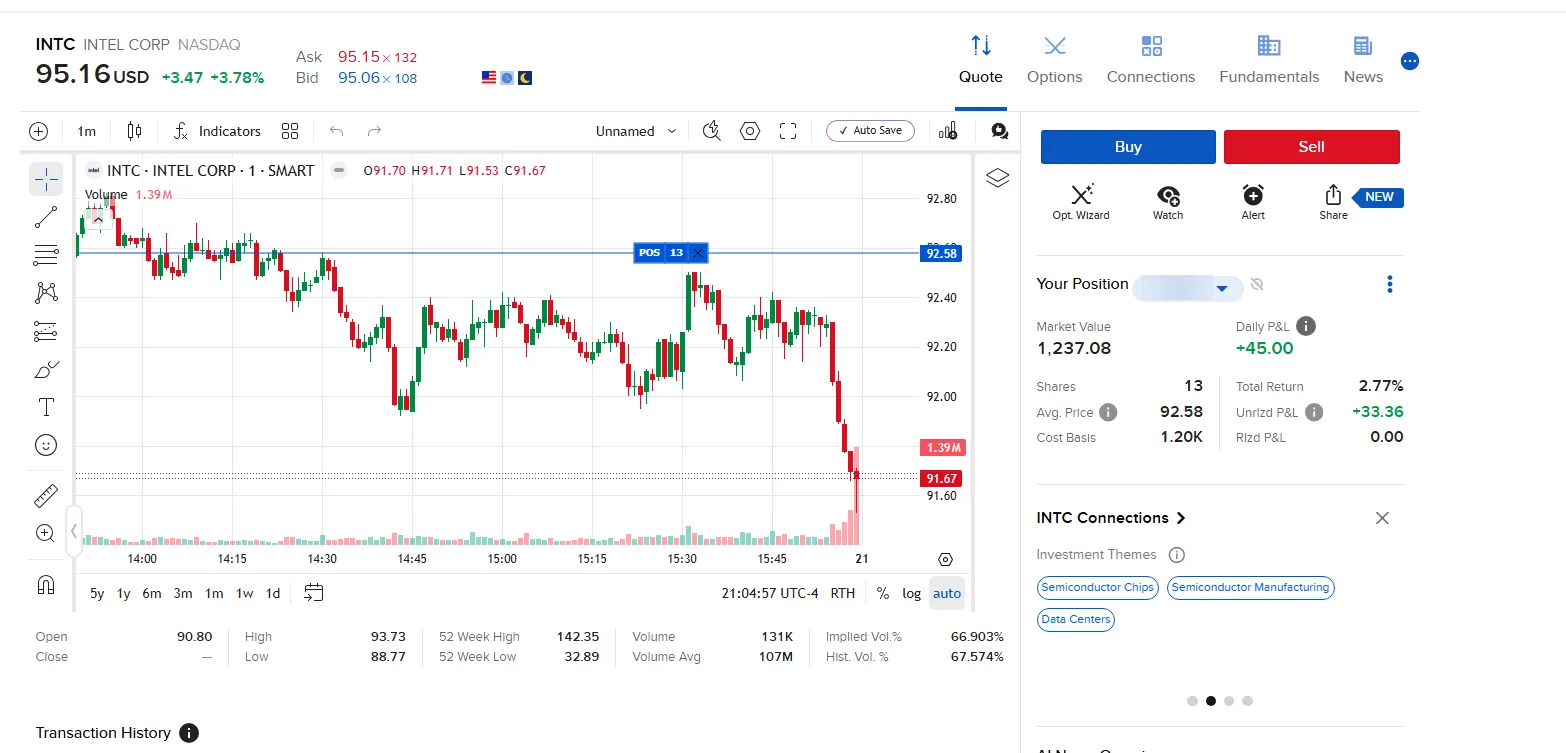
Further dated follow-ups will be added below this line as the trade develops. The sections above will not be edited.
Closed on 22 October 2026, see Intel stopped out.
Added 31 October 2026. I now add a Basic TA block to every trade post. This one uses only daily bars up to the last close before I bought.
Basic TA at entry
INTC, as of the 19 October 2026 close, from IBKR daily bars.
| Indicator | Value | Read |
|---|---|---|
| Price | USD 92.03 | Close before I bought |
| MA20 | 111.07 | Price below: bearish |
| MA50 | 102.98 | Price below: bearish |
| RSI 14 | 34.7 | Weak, near oversold (30 and below) |
| Trend | Down from 127.44 (24 Sep high) to 92.03, then one up day | Short-term down |
| Support | 89.19 (16 Oct low), then 81.79 | First floor about 3% below |
| Resistance | 95.39 to 96.87, then about 103 (MA50) | Next ceiling 3.7% to 5.3% above |
| Volume | 72.9M vs 71.3M average | About average |
| Trigger | 92.03 vs previous high 94.22 | Not fired |
Overall read: price below both averages, RSI near oversold, trigger not fired.
Sources
- Motley Fool, “Why Intel Stock Popped on Monday”, 19 October 2026 (JPMorgan upgrade details and market share figures).
- Tradingpedia, “Intel Rallies on JPMorgan Upgrade and Tesla Foundry Deal”, 19 October 2026.
- StockAnalysis.com, INTC price history, retrieved 20 October 2026.
- TheRightTrader.com, INTC earnings calendar and consensus, retrieved 20 October 2026.
- Investing.com, INTC technical analysis page, data timestamped 19 October 2026.
All figures are as reported by those sources on those dates. They are not independently verified and may have been revised since.
Updates to this post
| Date | What changed |
|---|---|
| Added a Basic TA block (data as of the 19 Oct close, before the buy) | |
| Added the closing line linking to the exit post |
This is a record of one trade and the thinking around it, written by someone learning in public with money he can afford to lose. It is not advice. If you are thinking about a trade, do your own work and decide for yourself.