A week after I bought Applied Materials, the stop sold it for me at half past three in the morning. This closes trade #3 in the AI-assisted series. Same rules as before: Claude called it, I decided, the stop was placed with the buy and I did not touch it.
Trade summary
| Action | Sold (stop-loss triggered) |
| Ticker | AMAT, NASDAQ, USD |
| Quantity | 3 shares |
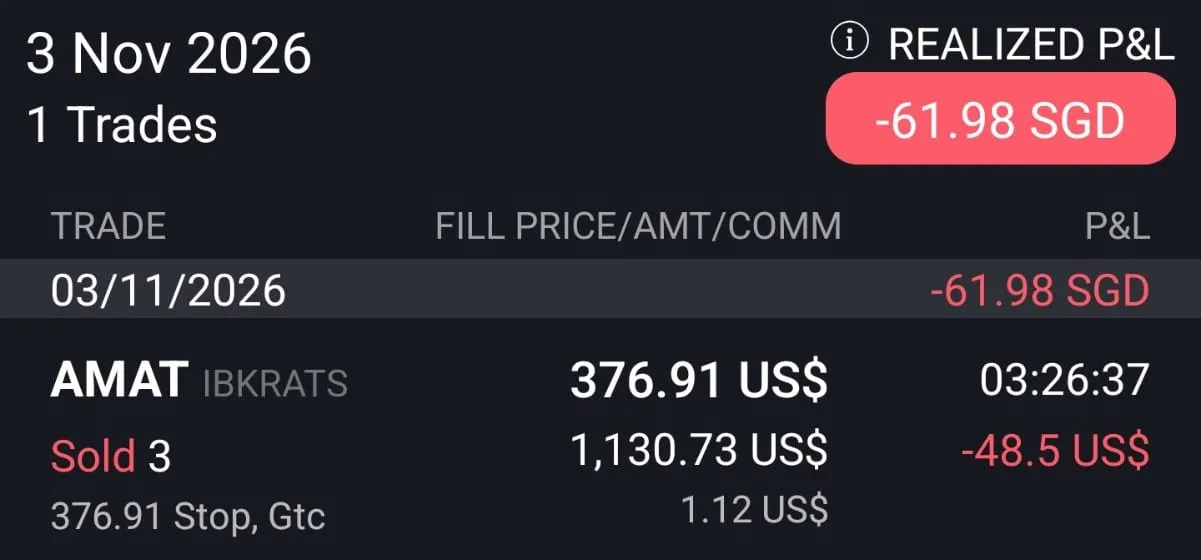
| Exit price | USD 376.91 (stop 377.00, GTC) |
| Proceeds | USD 1,130.73, commission 1.12 |
| Executed | 3 Nov 2026, 03:26 SGT (2 Nov, 14:26 ET) |
| Entry | USD 392.37 on 27 Oct 2026 |
| Realised P&L | USD -48.50 after fees (-3.9%), from IBKR |
| Days held | 7 (5 sessions) |
| Followed the plan | Yes |
What triggered the sell
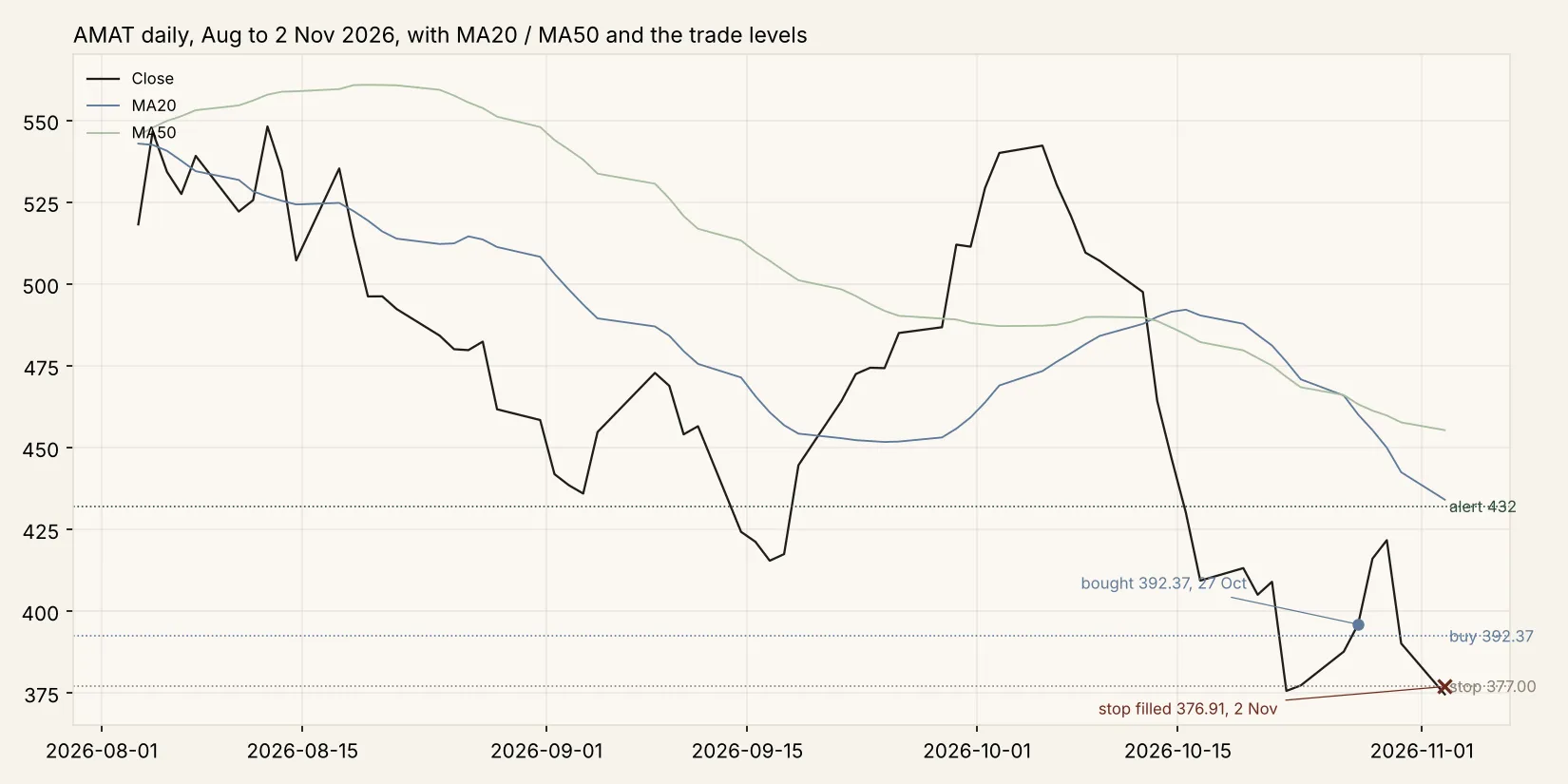
Nothing I did. The 377 stop went in with the buy ticket on 27 October and sat there. On 30 October AMAT dropped 7.5% to 390.09 in the semiconductor sell-off and closed 13 dollars above the stop. On 2 November it opened at 395.27, a few dollars above my entry, traded as high as 399.19 in the first hour, then slid through the afternoon. The stop fired at 14:26 New York time, 03:26 in Singapore. The stock closed that day at 374.53.
What executed
Stop order 377.00 GTC, filled at 376.91 on IBKR’s ATS. Three shares, 1,130.73 in, 1.12 out in commission. IBKR shows the realised loss as 48.50 US dollars, or 61.98 Singapore dollars.
Why I sold
I didn’t choose to. The plan did. That is the point of the stop: the decision was made on 27 October with a clear head, not at three in the morning.
Basic TA at exit
AMAT, as of the 30 Oct 2026 close, from IBKR daily bars.
| Indicator | Value | Read |
|---|---|---|
| Price | 390.09 | Below both moving averages |
| MA20 | 442.43 | Price 11.8% below; MA20 falling (468.97 twenty sessions earlier) |
| MA50 | 457.66 | Price 14.8% below |
| RSI 14 | 36.3 | Weak, not yet oversold |
| Trend | Down | Lower highs since the 2 Oct peak at 547 |
| Support | 372.80 (23 Oct low) | 4.4% below price |
| Resistance | 426.52 (29 Oct high) | 9.3% above price |
| Volume | 4.86M vs 3.90M 20-day average | Above average on a down day |
Overall read: a bounce that failed inside a downtrend. The stop at 377 sat 1.1% above the 23 Oct support and 3.75 above the 2 Nov low of 373.25. The stop went; support held.
Did I follow the plan
Yes. Stop placed with the buy, never moved, never cancelled. Target alert at 432 never came close. This is the second stop exit in three trades and the first where everything ran exactly as written.
Claude
Claude called the entry on the trigger rule: the 26 October close above the previous day’s high. Three shares, limit 397, stop 377, alert 432, decision point 11 November before earnings. On 2 November, when I asked whether to sell AMAT and roll the money into NVDA, Claude said red on the swap and keep AMAT to plan.
Me
I kept AMAT to plan. I was awake when it opened above my entry, and I did not sell. The stop did the rest.
What Claude got right and wrong
Right: the sizing. Three shares at a 4% stop meant the loss is about the price of a dinner. The red on swapping into NVDA the day after a 7.5% drop still looks right.
Wrong: the entry. The trigger fired, but it fired on a one-day bounce with the price about 17% below both the 20-day and the 50-day averages. Three trades in, every buy has been a bounce below both averages. Two of them hit the stop. The trigger rule tells me the day is up; it does not tell me the trend is.
The trigger rule tells me the day is up; it does not tell me the trend is.
What I’d change
- Add one line to the entry check: is price above the 20-day average? If not, say so out loud before buying.
- When a trade opens above my entry the morning after a bad day, and the trend is still down, sell at the open. That was a free exit at 395 and I let it go.
- Nothing on the stop itself. A 4% stop on a 7% daily mover is tight, but it did what a stop is for: it capped the loss at three in the morning without me having to decide anything. The 10-trade review will say whether that is too tight.
Series so far
Three trades closed: one target, two stops. Realised: +USD 11.20 on the most I had at work at once. Followed the plan 3 of 3. The fourth, Amazon, was bought the same night; it gets its own post.
Sources
- IBKR Trades and Orders, 3 Nov 2026 03:27 SGT (fill, commission, realised P&L).
- IBKR daily bars, AMAT, 7 May to 2 Nov 2026 (moving averages, RSI, support and resistance, 2 Nov open and close, computed and drawn in code).
- Entry post, 27 Oct 2026, for the call and the levels.
This is a record of one small trade in my own account, written to learn from. It is not advice. Claude is an AI tool, not a financial adviser, and neither am I.