I have accumulated years of photographs. Taking them was never the difficult part. The problem came later, when I wanted to find a particular place, remember the order in which things happened or turn hundreds of pictures into something worth writing about.
I host Immich locally on my TrueNAS server. The photographs remain on equipment I control, while Immich gives me a convenient way to browse them by date and location, organise them into albums and return to trips that might otherwise remain buried in a large library.
More recently, I have started using those albums to help build the travel stories on Thawaio.
A separate album as a boundary
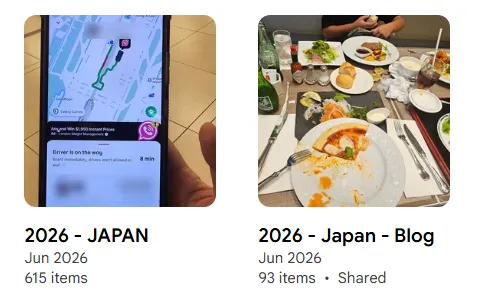
The main album from our Japan trip contains more than six hundred photographs. I did not want a tool going through all of them, especially when many show my family or moments I have no intention of publishing.
Instead, I created a separate album called “2026 - Japan - Blog” and added only the photographs I was comfortable using. That still left more than ninety images, but it created a clear boundary between the private trip album and the material available for the blog.
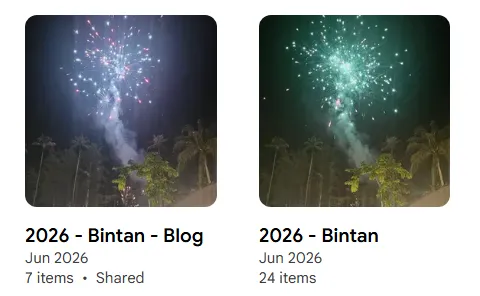
I used the same approach for Bintan, although that blog album contained only seven selected photographs.
The blog albums are not backups or second copies of the entire trip. They are curated selections. Adding a photograph means I am comfortable allowing it to be considered for the site. It does not mean it must be published.
Keeping the connection limited
I created a separate Immich user for the blog and gave it viewer access only to the selected albums. I also created a restricted API key so the intake tool can read those albums without changing anything in Immich.
The tool checks for the exact album name, confirms the number and type of files and downloads preview-sized images rather than the originals. It cannot delete, edit or upload anything.
The photographs are ordered using their capture times. Immich’s general location information helps identify where a picture was taken, while the precise coordinates remain private. When an image is prepared for the website, its embedded metadata is removed, including any device or location information.
This gives me a useful working copy without placing the original photographs or the rest of the library inside the website project.
Metadata gives me the order, not the story
The dates and locations helped reconstruct the Japan trip. They showed when we moved from Tokyo to Yamanashi, Nagano, Kyoto and Nara. They also helped check parts of the itinerary against what we actually did.
But metadata has clear limits.
It could not explain that Tokyo was included largely because my son had been asking to visit the Pokémon shop and Kirby Café. It could not know that I became ill in the Kiso Valley, or why part of a planned walk ended early. A photograph of the deer in Nara could show what happened, but not how excited my son was when some of them bowed back to him.
Those details came from memory and conversation. In several places, the first draft had to be corrected because an itinerary described what we intended to do rather than what actually happened.
The photographs provide evidence and prompts. They do not replace the person who was there.
The backup I still need
There is an important weakness in my setup: I do not yet have a separate backup.
Immich runs locally on my TrueNAS server, but the server holding the library is not itself a backup. Immich helps me organise and find the photographs, but if the only usable copy depends on the same system, it is still vulnerable.
I need another copy of the original photographs and the information Immich uses to organise them. That copy should not depend on the same TrueNAS server, and I should test that it can actually be restored.
Until I have done that, I can say that TrueNAS and Immich have made my photographs easier to manage. I cannot honestly say that they are properly backed up.
Making the archive useful
The most valuable result so far is not the technical connection. It is that the photographs are beginning to become stories instead of remaining a large collection I rarely revisit.
The separate album gives me control over what can be considered for publication. The metadata provides a starting order. The previews make review easier, and the final web copies contain no private location or device information.
The rest still requires judgment. I decide which photographs belong, which family moments remain private and what the trip actually meant.
The next practical job is the backup. After that, there are many more years of photographs waiting to be revisited.